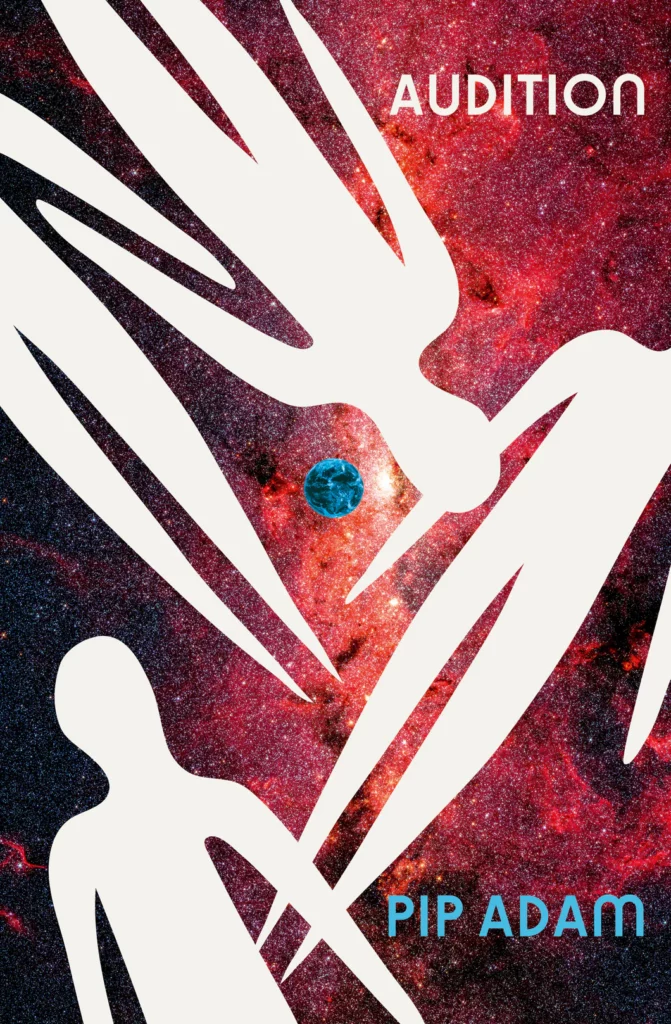
If you can forgive the trite tactic of opening an essay with a definition, you might be interested to know that audition, which we mostly use to mean trying out for some sort of performance, earlier meant to be heard in a court of law and, before that, the very act of hearing. In Pip Adams’ novel Audition, some helpful aliens are here to remind its characters, and therefore readers, that the popular use is not the chief one at play here:
‘Is this a test?’ Alba says.
‘No,’ says T.J.
‘But you’re testing us?’
‘No,’ says R.J. ‘We are not testing you.’
Shortly after, the humans question where they should sleep. ‘Where do you want to sleep?’ the local says. Alba understands it’s not a test. The choices, the freedom, are a way for them to get to know themselves.
Audition is fundamentally concerned with the judgment of law; with, particularly, our insidious system of mass incarceration, and its distance from a system that gives people the freedom to get to know themselves. It is, perhaps, a bit of a spoiler to say so, but it’s all over the blurbs for the novel, so we’re going to take it as a given that readers know that going in. It opens with three people—Drew, Stanley, and de facto main character Alba—imprisoned on a spaceship (called, of course, Audition). If they talk, the ship is propelled forward and they stay the same size. If they’re quiet, the ship stops and they grow, even though they’re already of giant proportions. It’s an apt (and unsuitable) metaphor for the thematic question of who gets to take up space in society, and who is treated as if they’re taking more than their share just for existing.
Audition is not just a radical work in its approach to anti-carceral abolitionism, but in its structure and tone. Its tripartite structure opens with a post-Beckettian fugue giving way to almost social-realist prison misery opening up into truly alien ontologies and social structures. There’s something of Lanark at play not only in the book’s politics but in its plunge into surreality before pulling back into realism that gives way again. The fugue of the intro is particularly masterful, with the amnesiac giants trained to fall into familiar vocal rhythms, perfectly capturing the inertia of their situation. They echo and drone along with the prose, a hypnotic dirge reiterating over and over how “stupid” they are, what “a beautiful job” their captors have done with the ship.
This endless dialogue is a distraction from their misery, uncomfortably jammed into the sharp confines of the ship. These contortions are mirrored in the giants’ search for the right shape of a story to tell themselves to explain how they ended up here. These stories—which I originally took to be evidence of some sort of collective identity on the part of the giants because of their multiplicity and contradictory natures—turn out to be misremembered plots from popular romantic comedies, their failed attempt at grasping meaning out of pop culture.
As their memories return to them, their stories are revealed as something much more miserable and prosaic: they were prisoners, jettisoned from Earth because they were taking up too much space. The misery of their babbling mirrors the miserable ambiance of modern society, the inertia of cycles of violence they’ve been unable to escape, the loudness and pride literally beaten out of them in prison. It’s a hellish interlude, in fiction as in life, and indeed the title of this section of the book—“On the Edge of the Gates of Hell at the End of Space and Time” —seems initially to refer to the destination of the spaceship before revealing itself to mean its place of origin: the carceral hellstate on Earth.
I have to make particular note of the book’s style as the ship’s journey comes to an end; Adam’s prose is remarkable throughout but the poetics of this section, a transition point as the characters reject their conditioning and the book releases its droning repetition and peaks in harsh surreality before turning to harsher reality (and then a gentler alien unreality) are downright incredible. The final third of the book, where they’ve landed on a planet wildly surreal and impressively alien, notably also features aliens attempting to rework bodies as they materialize “slightly off but so Earthling-shaped. Earthling-shaped but in a performative way.” Adam excels in her depiction of the aliens, helpful but un-human enough that they come across as threatening, or at least unsettling, as often as not (as when they answer “Am I dead?” with “Not yet.”).
Audition succeeds so admirably because of its commitment: it takes genre seriously, it takes surreal craft seriously, and it takes radical politics seriously. There’s no winking or self-consciousness about its approach. It’s about finding the right shape, finding equilibrium rather than hurtling along due to inertia. The book becomes a dichotomy between two systems of justice: one punitive, and one, an alien but more humane system, that allows them choices and freedom to know themselves, to atone, and to grow. The most alarming thing about Audition is that it requires such an alien landscape and ontology to allow them to do so.
Zachary Gillan
Zachary Gillan (he/him) is a critic of weird fiction residing in Durham, North Carolina. He’s an editor at Ancillary Review of Books, the book reviewer for Seize The Press, and his work has appeared in Strange Horizons, Los Angeles Review of Books, Interzone, and Nightmare Magazine, among others. He can be found at doomsdayer.wordpress.com and @megapolisomancy.bsky.social