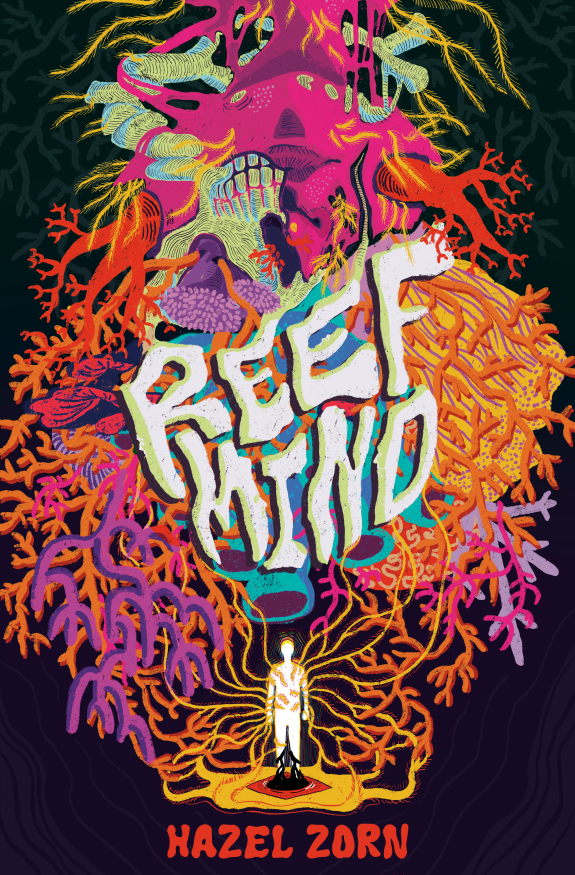
Hazel Zorn’s Reef Mind is a novella about the total transformation of the world into something new, alarming, exciting, terrifying, and enthralling. That’s right: it’s a story about becoming a parent. It’s also about climate change, relationships, grief, compassion in the midst of overwhelming trauma, and the numinous alien underwater world. Despite some unevenness in the prose, it has a real flair for the surreal visuals and weird unsettlement brought about by its setup, and doesn’t shy away from the conflicts and unresolvability of its thematic core.
The book focuses on Matt and Amanda, a married couple unable to have children, both “burdened with the frailty of human life”, as the sea begins to take over the world. The book’s structure, largely alternating between Matt and Amanda’s viewpoints, shifting forward and backward in time and playing with points of view and addresses, is particularly apt for the material, capturing the uncertainty of this ontological shift and the collapse of civilization around them. This push and pull starts unsettling things quickly, opening with Matt and then immediately undercuts his assumptions about himself with the following Amanda section.
The rise of the sea is not, in a fascinating, weirded twist, literal, as in most post-apocalyptic climate fiction. Rather, sea life itself begins to colonize the land, sharks and jellyfish floating through the air, twisted columns of coral overtaking the buildings of La Jolla. The breakdown of society is captured quickly but convincingly, the characters realizing “[t]here were no more doctors to call, no hospitals that weren’t overgrown with psychedelic anemones and stalked jellyfish. I grew up with faith in social structure. There was always someone to call. A doctor, a senator, an expert.” This anxiety about the new world, supposedly previously stable and reliable, suffuses the novella. As Matt and Amanda find themselves caring for a new form of life, it finds particular expression in the parental anxiety about the world we leave behind for our children, and the children we leave behind for the world.
The ocean is an incredibly fruitful environment for weird fiction, and Zorn’s transposition of its flora and fauna onto the land suits her strength in writing compelling visuals and set pieces throughout the surreal collisions between marine and land life:
The skeletal structures were blooming, stalks growing and putting out limbs, algae colors carpeting columns and shelves. I was drawn to a field of crinoids. Their limbs waved innocently in the air. Living feather dusters. Beautiful, if I was honest. Ethereal. In the center of those flowering structures were white replicas of human faces; the same two faces repeating over and over, their eyes shut and their mouths whispering silently.
Elsewhere, Matt walks through a forest infested with fish “as loud as any birds. The babbling, clicking, and sometimes low moans that sound like roars usually warn of lionfish.” It’s an incredibly evocative scene, but that last clause stumbles over itself in trying to convey it. As the sea begins to rise, Amanda finds an abandoned child, infected and then horribly remade by the reefmind, as Amanda herself will come to be:
The boy’s bones cracked and snapped inside him, ballooning his little chest. His ribcage sprouted, popped several joints, and heaved upward of its own volition, leaving beneath it the former meat overcoat. It crab walked toward me just as the head it left behind turned and let out a raspy noise. A fragment of a small voice.
The unraveling of the boy before me destroyed the mind I had, smashing my sanity to bits. This thing replaced my love of the ocean with a vast and dark fear and a more incomprehensible silence, like a night without stars now dominated the ruin of our insect-like civilization.
This passage captures many of the strengths of Zorn’s voice—the visuals, the physicality of the awful body horror, the empathy at the heart of the novella—but “the former meat overcoat” is a clumsy formulation, as is “insect-like civilization”. You can see what both are intended to evoke, but they don’t work in and of themselves. It’s notable that both tend toward the cliche, of splatterpunk and cosmic horror, respectively; Zorn’s prose is much stronger when she’s letting the idiosyncratic weirdness of the work shine through.
It’s telling, though, that it’s the death of a child (seemingly, at any rate; the dissolution and incorporation of human beings into the communal reefmind is more complicated than “death” as we know it) that shatters Amanda’s sanity. Amanda, who was much more deeply invested in wanting children than Matt ever was, evinces some strains of antinatalism from time to time. Rather than nihilism, though, it comes from a rage enkindled by an empathetic refusal toward the violence and pain the world inflicts on all of us, and on vulnerable children in particular. Amanda is motivated by the trauma of two miscarriages and a stillbirth suffered in her previous marriage; Matt characterized by his insistence on either blithely ignoring or justifying the trauma inflicted by his own abusive father. The reefmind picks up, feeds on, and channels these fears and pains.
But the book recognizes that lines of influence flow not just from parent to child but from child to parent. It also picks up on the conflict, the confusion, the struggle between life and death, between nihilism and meaning. It’s about bridging the divide between parents and children, which is mirrored in the reefmind’s co-optation of memories and weird doppelgangers of loved ones and the discovery of an alienated humanity within the reef child. The novella is rife with questions but not answers, in true weird fiction fashion, down to its remarkable last line.
The unanswerable dilemmas of parenting provide the liminal weirdness that drives the book as much as the resurgent sealife does. Much of the book takes the form of a monologue from Matt to the coral child, which puts the narrative in the interesting position of explaining normalcy and humanity to the weird forces attacking it, even as he’s justifying his (ineffective) violence toward the creature, just as he once justified his own childhood abuse to Amanda. There are some very interesting parallels here with Thomas Ha’s novelette “Uncertain Sons”: the wrecked remnants of southern California, remade by some biological, alien force; communication between parent and child; the valences of violence and death and questionable legacies. Children, be they flesh and blood or coral and algae, are their own fully realized beings, and parents have to remember, as Matt does, that “[c]hildren cannot be fully possessed, nor fully protected.” These are important ideas to ponder, and Reef Mind achieves a remarkable synthesis of theme and weirdness as it does so.
Zachary Gillan
Zachary Gillan (he/him) is a critic of weird fiction residing in Durham, North Carolina. He’s an editor at Ancillary Review of Books, the book reviewer for Seize The Press, and his work has appeared in Strange Horizons, Los Angeles Review of Books, Interzone, and Nightmare Magazine, among others. He can be found at doomsdayer.wordpress.com and @megapolisomancy.bsky.social