
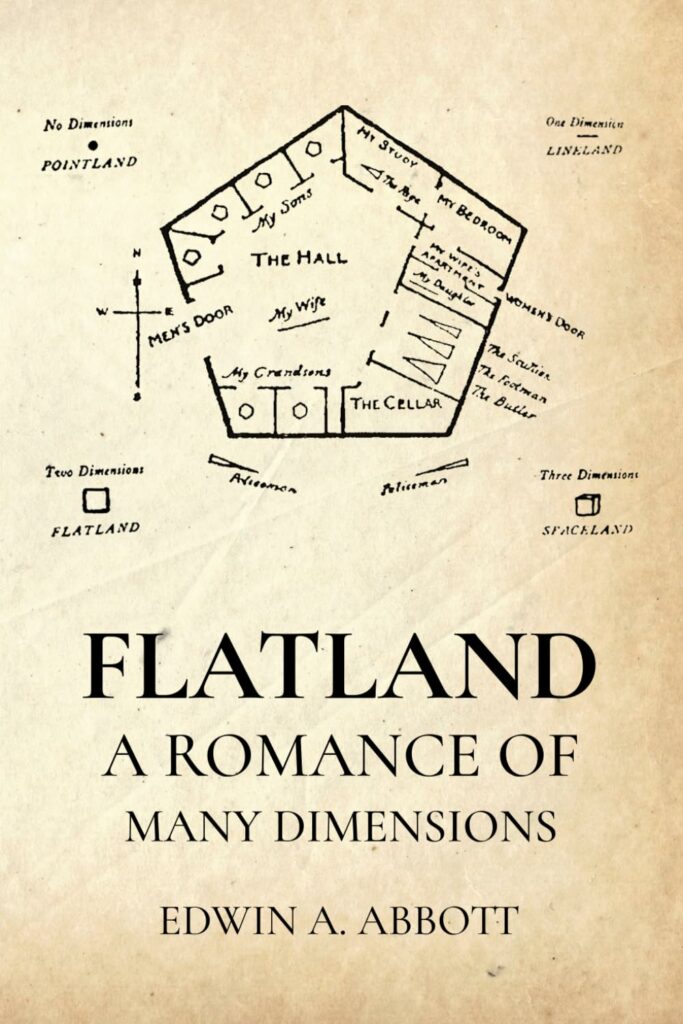
Flatland by Edwin Abbott Abbott, the tale of a square who lives in a two-dimensional plane, has charmed readers since its initial publication in 1884. But while modern readers still enjoy the second half of the book, where the square meets a sphere and discovers the existence of other dimensions, many are troubled by the first half, where the narrator describes his two-dimensional world and its culture. The description is rife with sexist, classist, and eugenicist ideas. Are these passages satire, or are they intended to be an accurate reflection of Abbott’s own opinions?
The inhabitants of Flatland are geometric shapes who live within a rigid class system based on their number of sides, with circles at the top and isosceles triangles at the bottom, with irregular shapes condemned as degenerates and imprisoned or destroyed. Women are straight lines and are therefore the lowest class of all, believed to have no intelligence and given no rights.
Certainly, there are many parts that read as obviously evil if taken literally, such as this passage about shackling lower-class shapes to starve to death in schools to teach children about shapes:
Fettered immovably so as to remove all possibility of danger, they are placed in the class rooms of our Infant Schools, and there they are utilized by the Board of Education for the purpose of imparting to the offspring of the Middle Classes that tact and intelligence of which these wretched creatures themselves are utterly devoid.
In some States the Specimens are occasionally fed and suffered to exist for several years; but in the more temperate and better regulated regions, it is found in the long run more advantageous for the educational interests of the young, to dispense with food, and to renew the Specimens every month—which is about the average duration of the foodless existence of the Criminal class.
Women, meanwhile, are “little better than ‘mindless organisms’” with “absolutely nothing to say, and absolutely no constraint of wit, sense, or conscience to prevent her from saying it”, and the narrator muses that it might be better to get accidentally stabbed by a woman’s pointy end than to listen to her talk.
Opposing viewpoints do poke through, such as an activist pleading for the irregular shape, who is “from his birth scouted by his own parents, derided by his brothers and sisters, neglected by the domestics, scorned and suspected by society…what wonder that human nature, even in the best and purest, is embittered and perverted by such surroundings!” But the narrator writes completely in earnest, which is not much help to a modern reader—it’s difficult to know if this is Swiftian satire, meant to be seen as obviously false and exaggerated to contemporary readers, or if it’s more like Kipling, meant in earnest at the time but obviously abhorrent today.
To find our answers, we must look beyond the text and to the person. Who was Edwin Abbott Abbott? And what else did he write?
Abbott was a cleric of the Church of England, and much of his writing is on theology. So what can his theology teach us about Flatland? Most of Abbott’s theology books are written from the point of view of characters from Biblical times. But this makes it hard to judge what is Abbott’s opinion and what is the opinion of the potentially unreliable narrator. For this reason I’ve mainly focused on The Kernel and the Husk (1886), which is written from his own point of view.
Abbott was a deeply unorthodox theologian. He was a religious pluralist who didn’t believe in Heaven, Hell, or miracles, including the physical resurrection of Christ. He rejected literal interpretations of most of the Bible as ahistorical. Clearly this was a man who didn’t mind slaying a few sacred cows.
So perhaps it’s unsurprising to discover that he was staunchly progressive and opposed to all forms of oppression. He urges his readers to follow their conscience and reject the “distorted and narrowed conception of it conveyed to him by his “set, his class, his city, his nation, or his church…to protest, for example, against unjust wars, against war of any kind, against slavery, against duelling, against legalized oppression.” He loathes the Bible being used to justify oppression, especially “the gigantic evil of slavery”. “It is not in accordance with the Bible—and still less in accordance with the spirit of the New Testament and of Christ—that any nation should tolerate and perpetuate the misery of a class in order that the whole nation may prosper”.
That pretty well blows up the eugenicist aspects of Flatland. While the narrator of Flatland staunchly defends its rigid class system as unavoidable, Abbot himself believes that “If, by descending a step or two lower in the scale of comfort, the comfortable classes could lift the very poor a step or two higher, the Church ought not to help the rich to shut their eyes to their obvious duty”.
What about the women, though? While Flatland dedicates a chapter to them, the oblique mentions they receive elsewhere in his work are not promising. He bemoans that belief in Hell “has exercised a baneful influence upon many women and children; but the majority of healthy men who profess to believe in a pit of flame are little influenced by it”. Discussing Christ’s appearance to the women at the tomb, he suggests that early apostles “might naturally have desired to give less prominence to the testimony of highly imaginative and impressionable witnesses”; a generous reading might say that he means “witnesses that men in Bible times would have considered impressionable,” but it becomes glaring that all Abbott’s fictional perspectives involve thinking that women are silly.
He tips his hand near the end of Flatland, but it also illustrates his limitations. The narrator explains that:
With Women, we speak of “love”, “duty”, “right”, “wrong”, “pity”, “hope”, and other irrational and emotional conceptions…but among ourselves…”Love” then becomes “the anticipation of benefits”; “duty” becomes “necessity” or “fitness”; and other words are correspondingly transmuted.
Coming from a cleric, this is transparently satirical. Obviously he intends us to understand that the women have the right of it and it is the dryly rational men, who reduce all emotions to an equation, who are wrongheaded and narrow-minded. Later on, the Sphere rebukes him that knowledge of the third dimension doesn’t make him “more just, more merciful, less selfish, more loving”. The narrator is surprised to hear these virtues praised:
I. “More merciful, more loving!” But these are the qualities of women! And we know that a Circle is a higher Being than a Straight Line, in so far as knowledge and wisdom are more to be esteemed than mere affection.
SPHERE. It is not for me to classify human faculties according to merit. Yet many of the best and wisest in Spaceland think more of the affections than of the understanding, more of your despised Straight Lines than of your belauded Circles.
Certainly, Abbott means this passage in praise of women. But it’s just the same old “men rational, women emotional” cliché that has powered sexism throughout the ages.
But while Abbott’s words can be belittling, his actions tell a different story, particularly in one sphere: Education. Abbott, a schoolmaster, was a strong advocate of education for both genders. Even in Flatland, the narrator urges the ruling class to “reconsider the regulations of Female education”—although only on the grounds that mothers who can’t read or do arithmetic could cause “the enfeebling of the Male intellect”.
In the preface to an 1884 homeschooling guide, Abbott says, “The increased educational opportunities now afforded to girls and women justify the belief that in the next generation mothers will take a large part in the teaching and training of the young” (Hints on Home Training and Teaching). So Abbott, unlike the narrator of Flatland, considers girls’ education an end in itself, and the reason educated mothers are important is that they can help their daughters have more opportunities, not just their sons.
And Abbott put his money where his mouth was. He worked with Frances Mary Buss, an important pioneer of women’s education; according to her biography, “Dr. Abbott, head-master of the City of London School, spoke very strongly on the duty of the Mayor and Corporation to provide for girls schools similar to those of their brothers” (Frances Mary Buss and Her Work For Education). One of her compatriots says “Dr. Abbott deserves more thanks than I can express”.
Abbott’s own daughter, Mary, graduated at the top of her class at Girton College, Cambridge’s first women’s college. Mary, a classicist, assisted her father with his monumental ten-volume theological work Diatessarica, which he dedicated to her.
How does all this square with his offhand dismissive remarks? Even Hints on Home Teaching and Training, despite its encouraging preface, mostly forgets the existence of girls, and while it usually refers to “the child” or “the pupil,” it reverts to “the boy” when discussing advanced subjects like Latin. Alas, they’re all too compatible. It’s easy to believe that one’s particular friends (and children) are exceptional but that women as a whole are irrational. And there’s no contradiction in thinking that women are overemotional and also thinking that they deserve an education.
It’s not only modern readers who aren’t sure how to interpret the world of Flatland. Enough of his contemporaries were also confused that Abbott added a preface to the second edition, which lays out his own views explicitly:
It has been objected that he is a woman-hater; and as this objection has been vehemently urged by those whom Nature’s decree has constituted the somewhat larger half of the Spaceland race, I should like to remove it…in the course of an imprisonment of seven years he has himself modified his own personal views, both as regards Women and as regards the Isosceles or Lower Classes. Personally, he now inclines to the opinion of the Sphere that the Straight Lines are in many important respects superior to the Circles. But, writing as a Historian, he has identified himself (perhaps too closely) with the views generally adopted by Flatland, and (as he has been informed) even by Spaceland Historians; in whose pages (until very recent times) the destinies of Women and of the masses of mankind have seldom been deemed worthy of mention and never of careful consideration.
Which confirms what we’ve seen from the rest of his writing and sews up most of our questions neatly.
Flatland’s hesitant modern fans can put their minds at ease. The world of Flatland is intended as satire, and the narrator’s contemptuous attitude towards women and the lower classes is deliberately meant to seem callous. When it comes to gender, Abbott is swimming in an omnipresent cultural current that he often (perhaps unconsciously, certainly uncritically) succumbs to, yet the real-life legwork he put in shows that he took women’s rights seriously, particularly in education. Abbott deliberately made the characters of Flatland narrow in mind and narrow in form to remind us all not to be a square.

Gwen C. Katz is an author, artist, and video game designer currently surviving the aftermath of the Eaton Fire with her husband and two cats in Altadena, California. When she’s not reading classic science fiction, she sells T-shirts on Etsy to help raise funds to rebuild her home. You can find more of her literary criticism at nightwellgames.com/articles.